
```html
In almost every implementation of a compliance program, the first finding is not a suspicious client. It's an empty column.
An income field that nobody filled in. A three-word address. A cell phone that says "N/A". None of those data points generate an error: the system, the spreadsheet, or the analyst accept them, the matrix calculates, monitoring runs. The rule doesn't fail: it does exactly what it was asked to do, with the data it was given. And at some point, without warning, a control stops finding what it should find.
That is the underlying problem with data quality in compliance: it doesn't fail, it turns off.
The problem is not local
Market figures point in the same direction:
USD 12.9 million per year. That's what poor data quality costs, on average, to an organization, according to a 2020 Gartner study.
47 %. On average, nearly half of newly created records have at least one critical error, and only 3 % of quality measurements proved acceptable. These are data from 75 evaluations across different sectors, published in Business Horizons in 2020 by Nagle, Redman, and Sammon.
45 %. The proportion of participants in the FATF/GAFI survey on new technologies against money laundering (2021) who cited data quality as a concern for adopting them.
And supervisors no longer treat it as an operational detail:
Monzo, United Kingdom, 2025. The FCA imposed a fine of £21 million. Among its findings, the bank had linked clients with limited information and, in some cases, evidently implausible: well-known London monuments declared as addresses.
Commerzbank London, 2020. The fine was £37.8 million. 1,772 clients had expired due diligence, and the monitoring tool was missing 40 high-risk countries and 1,110 high-risk clients.
Citigroup, United States, 2024. The Federal Reserve and the OCC imposed fines of approximately USD 136 million for insufficient progress in managing the quality of its data. Earlier, in 2020, the OCC had fined it USD 400 million for deficiencies in data governance.
The last case is not about money laundering prevention: it's about data governance and regulatory reporting. But it shows how far a supervisor's requirements on an entity's data quality now extend.
A compliance problem, not a technology problem
It's tempting to treat data quality as a systems department issue. It's not. Every piece of client data feeds a specific control, and when the data is missing, the compliance officer is the one exposed.
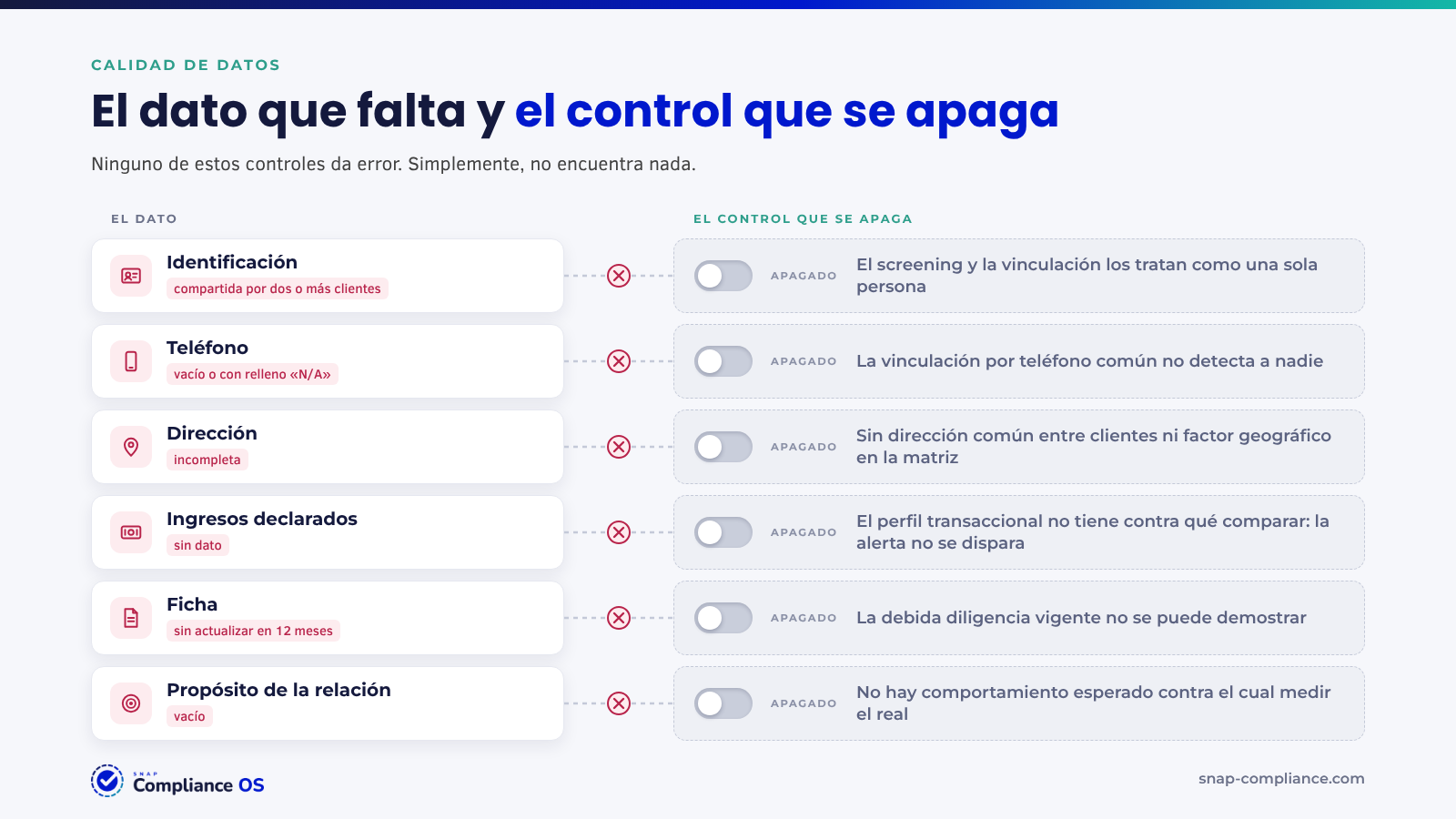
None of these failures appear in an error report. The alert for transactions incongruent with income doesn't trigger if there's no income to compare against. Linking by common phone number doesn't connect anyone if phone numbers are filler text. The supervisor, however, will find it: they just need to ask for a client's file.
How Snap Compliance OS verifies its clients' data
Snap Compliance OS includes a data quality module that reviews each client's file against specific rules and converts the result into a work list. The screens that follow are from the demonstration environment, with sample data.
An index that shows what breaks, not just what's missing
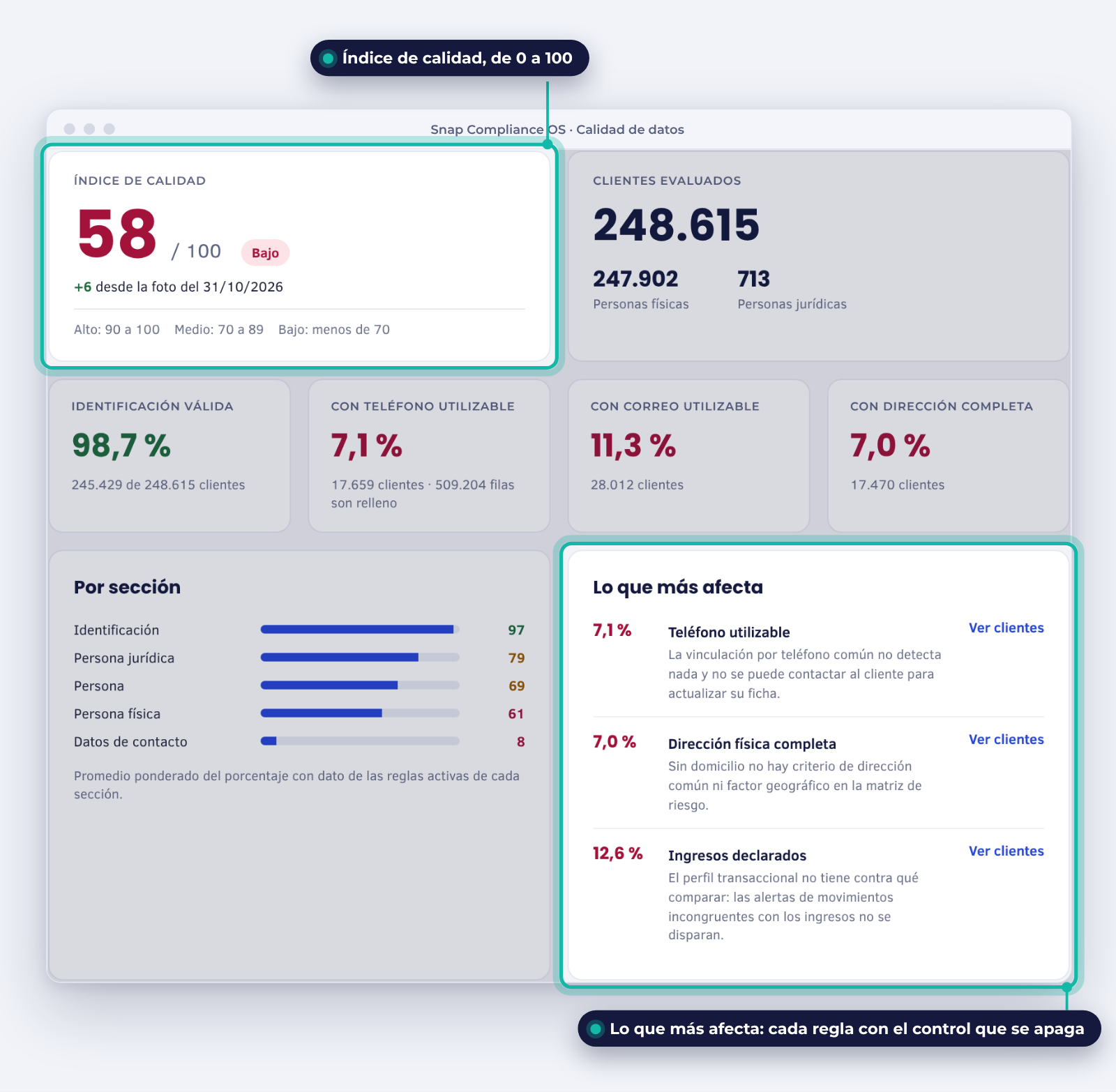
The summary brings together all active rules in an index from 0 to 100, by section: identification, person, natural person, legal entity, and contact data. The officer sees at a glance where they stand and how much has changed since the last snapshot.
What distinguishes this screen is the "What impacts most" column: each rule comes with the consequence written out. Without a phone number, common phone linking detects nothing and the client can't be contacted to update their file. Without an address, there's no common address criterion or geographic factor in the risk matrix. Without declared income, the transaction profile has nothing to compare against. And behind each figure, a link to the list of clients that need to be corrected.
Filler text is not corrected as an error
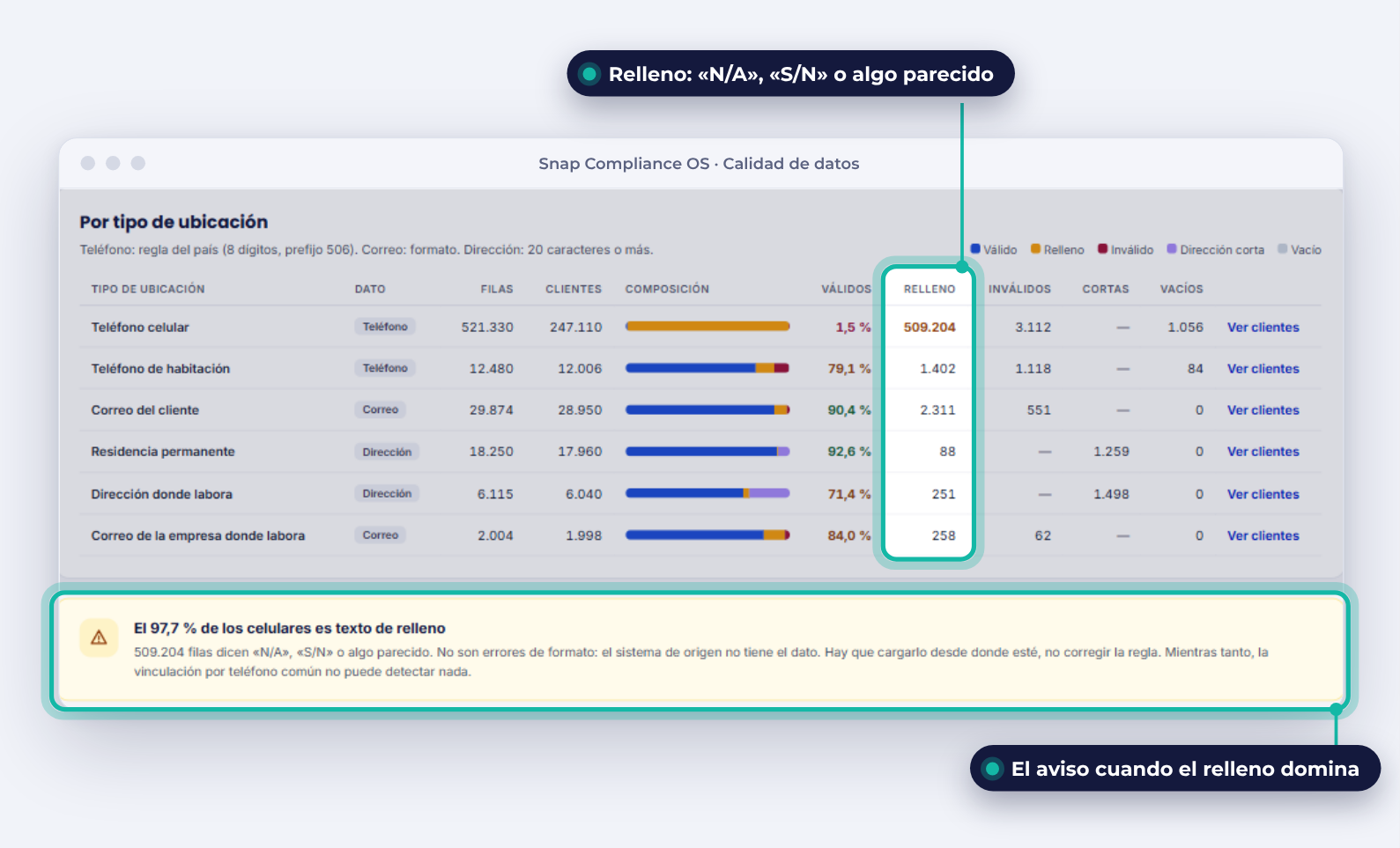
This distinction is what saves the most time. A format error, like a phone number with one digit missing, is corrected by adjusting the rule or the upload. Filler text is not. "N/A" or "N/A" are not misspelled: they confess that the data doesn't exist in the source system and that someone filled it in to be able to save.
The module separates them, location type by location type, and when filler text dominates it says so on the screen: you don't need to correct the rule, you need to get the data and load it. In the meantime, any control that depends on that data is, in practice, turned off.
The client file, rule by rule and in six states
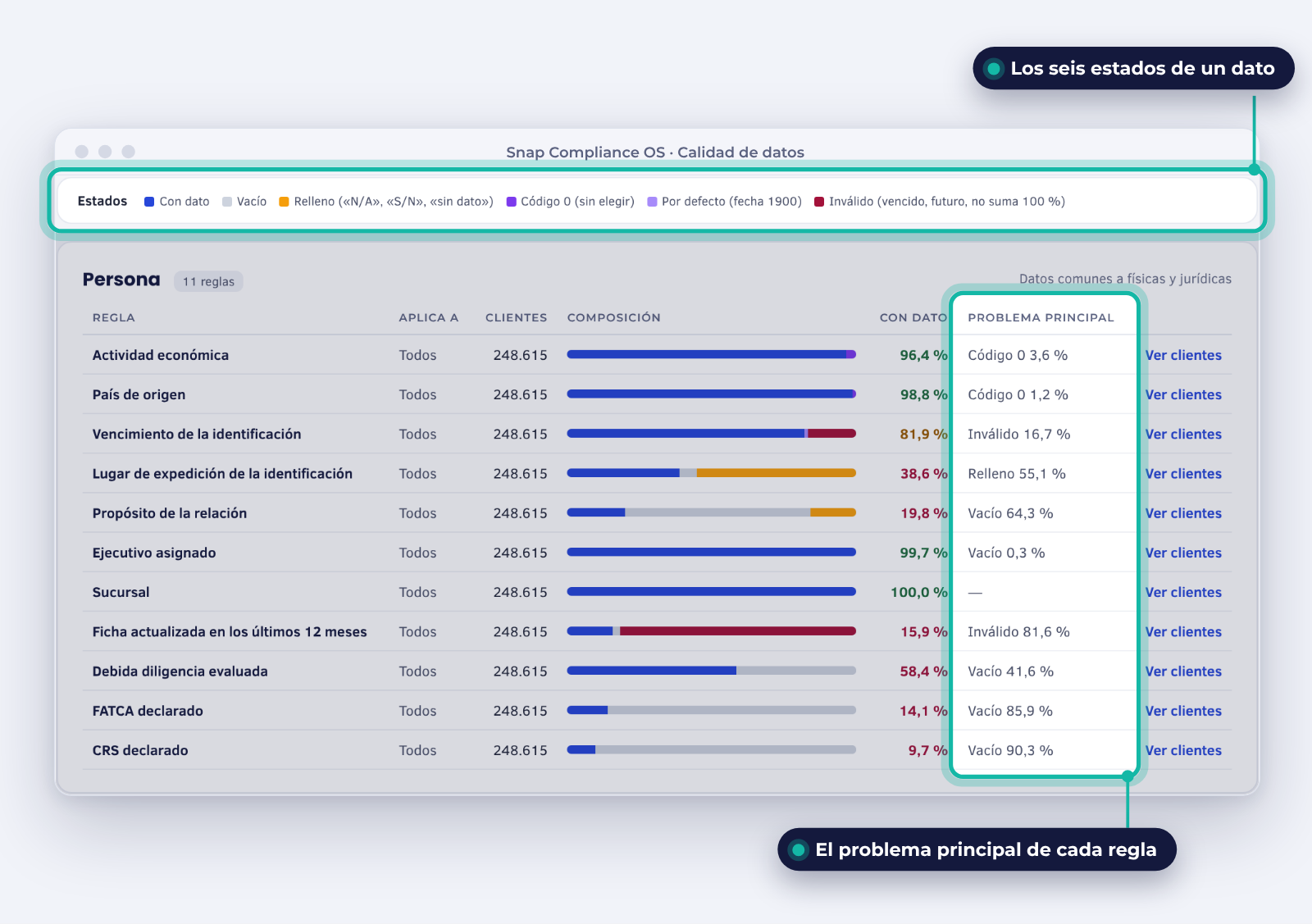
Not all bad data is the same, which is why the file distinguishes six states:
With data.
Empty.
Filler, like "N/A", "N/A", or "no data".
Zero code: the "not selected" from a list.
Default value, like a birth date of 1900.
Invalid: an expired identification, a future date, or percentages that don't add up to 100.
Each rule shows its composition and its main problem. Some carry direct weight with the supervisor:
File updated in the last 12 months: without it, current due diligence cannot be demonstrated.
Purpose of the relationship: without it, there's no expected behavior against which to measure the actual.
FATCA and CRS declared.
Improvement, measured snapshot by snapshot
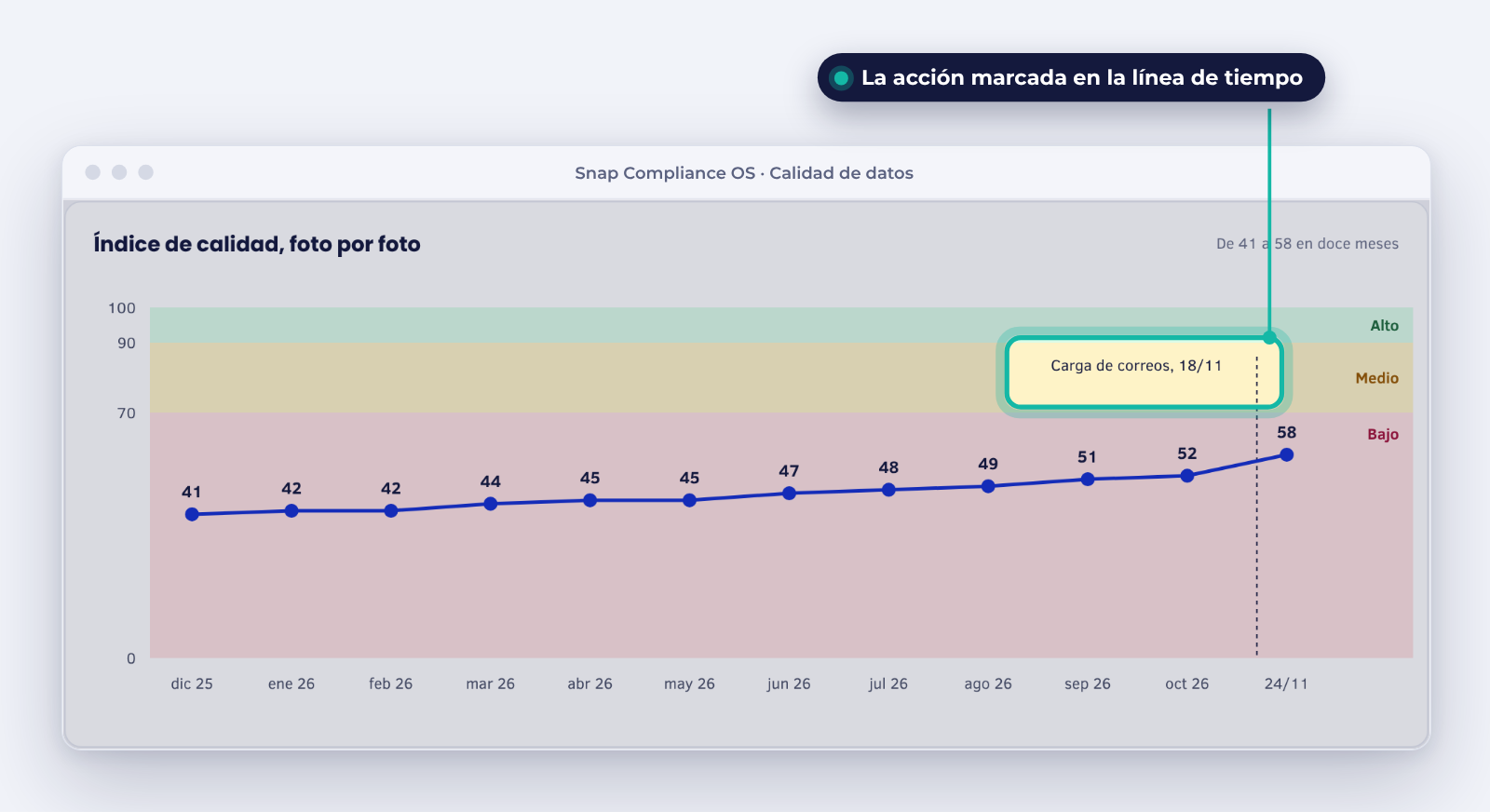
Each snapshot is saved. The evolution shows the overall index and that of each section over time, with actions marked on the line: an email upload, a correction of identifications. It's the difference between telling the committee "we're improving data" and showing them how much, when, and thanks to what.
What the compliance officer gains
Knows which controls are turned off, before the supervisor tells them.
Prioritizes with criteria: first the data that turns off the most controls, not the most visible.
Delivers concrete work to the areas that load the data: the list of clients, rule by rule.
Distinguishes what is corrected in the configuration and what needs to be retrieved from the source system.
Tests the improvement with a series of dated snapshots, for the committee and the supervisor.
What Snap Compliance OS does not do
We prefer to say it first:
Does not invent data. If the source system doesn't have the phone number, the phone number needs to be obtained.
Does not correct only the source system. It points out where the problem is and who the clients are; the correction is a project of the entity.
Does not replace the officer's judgment. It prioritizes; the decision of what to correct first is theirs.
Three questions to get started
Do you know what percentage of your clients have the declared income that your transaction monitoring uses?
How many of your clients share the same identification with another person?
If the supervisor asked today for the file of ten random clients, how many would be up to date?
If any of them doesn't have an answer, that's where the work begins: speak with a specialist.
The screenshots are from the Snap Compliance OS demonstration environment, with sample data.
Sources
Gartner, Data Quality: Why It Matters and How to Achieve It: https://www.gartner.com/en/data-analytics/topics/data-quality
Nagle, T.; Redman, T. C.; Sammon, D. (2020). Waking up to data quality. Business Horizons, 63(3), 325-337: https://ideas.repec.org/a/eee/bushor/v63y2020i3p325-337.html
FATF/GAFI (2021). Opportunities and Challenges of New Technologies for AML/CFT: https://www.fatf-gafi.org/en/publications/Digitaltransformation/Opportunities-challenges-new-technologies-for-aml-cft.html
FCA (2025). FCA fines Monzo £21m for failings in financial crime controls: https://www.fca.org.uk/news/press-releases/fca-fines-monzo-21m-failings-financial-crime-controls
FCA (2020). FCA fines Commerzbank London £37,805,400 over anti-money laundering failures: https://www.fca.org.uk/news/press-releases/fca-fines-commerzbank-london-37805400-over-anti-money-laundering-failures
Federal Reserve (10-07-2024): https://www.federalreserve.gov/newsevents/pressreleases/enforcement20240710a.htm
OCC (2024): https://occ.gov/news-issuances/news-releases/2024/nr-occ-2024-76.html
OCC (2020): https://www.occ.treas.gov/news-issuances/news-releases/2020/nr-occ-2020-132.html
```